Auxiliary Adjective (い) (Basic ㊦ 173)
Can't tell if ~
Equivalent: Might
| (i) {V/Adjective い} informal | かもしれない | |
| {話す /話した} かもしれない | Someone might talk/might have talked | |
| {高い /高かった} かもしれない | Something might be high/might have been high | |
| (ii) {Adjective な stem/ Noun} | {Ø/だった} かもしれない | |
| {静か/静かだった} かもしれない | Something might be quiet/might have been quiet | |
| {先生/先生だった} かもしれない | Someone might be a teacher/might have been a teacher |
【Related Expressions】
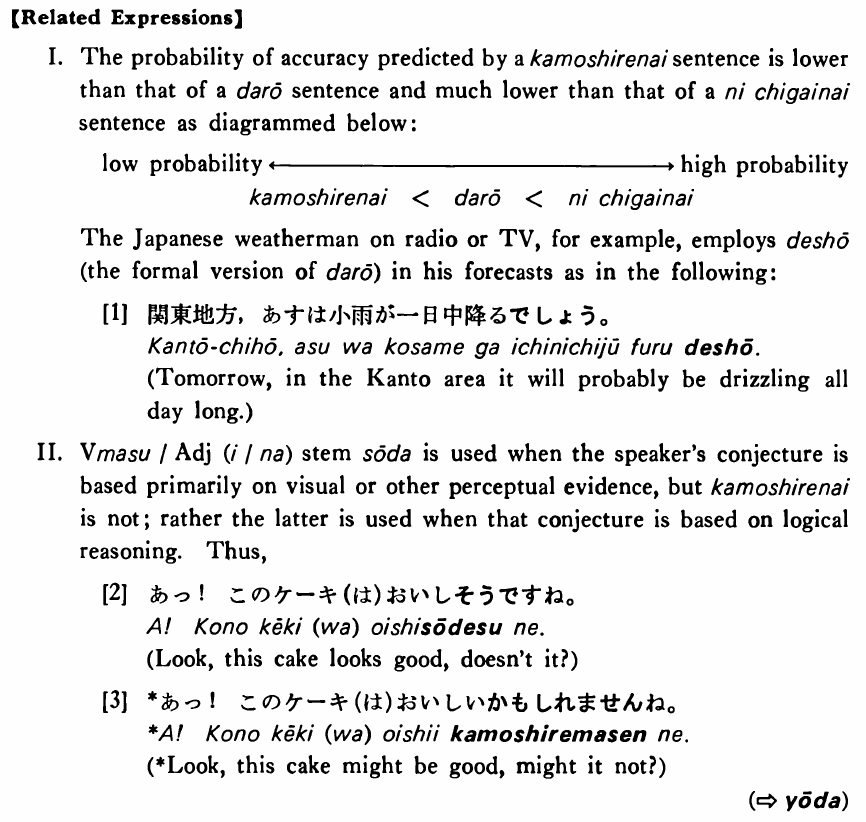
I. The probability of accuracy predicted by a かもしれない sentence is lower than that of a だろう sentence and much lower than that of a に違いいない sentence as diagrammed below:
| low probability | high probability | |||
| かもしれない | < だろう | < に違いない |
The Japanese weatherman on radio or TV, for example, employs でしょう (the formal version of だろう) in his forecasts as in the following:
[1]
II. Verbます/Adjective(い/な) stem そうだ is used when the speaker's conjecture is based primarily on visual or other perceptual evidence, but かもしれない is not; rather the latter is used when that conjecture is based on logical reasoning. Thus,
[2]
(⇨ ようだ)